
A reflection on learning and it is boring…
An essay…

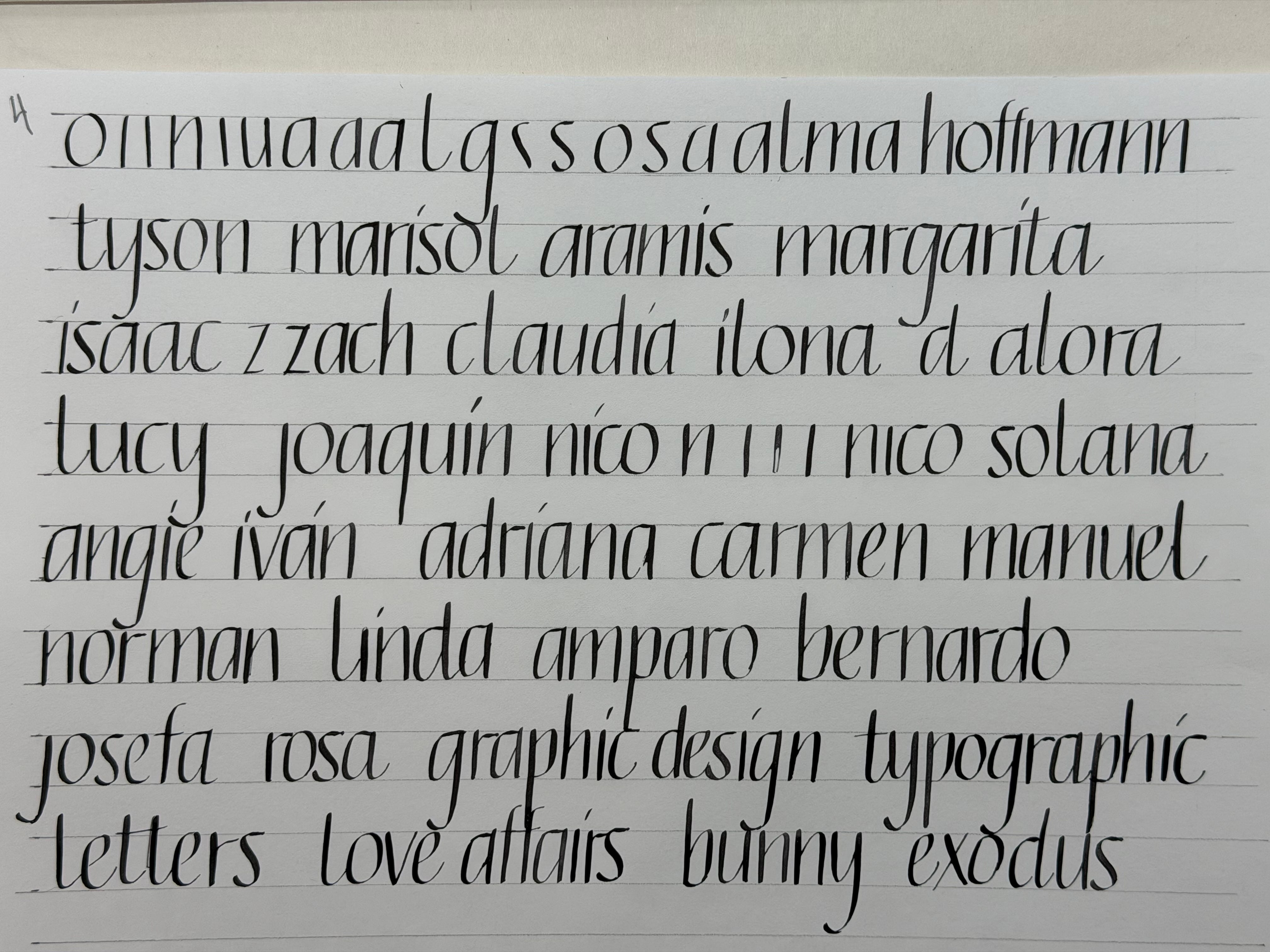
On previous posts I have referred to my studies of the historic Italic calligraphy hand under Gillian Hazeldine through the Society of Scribes and Illuminators (SSI). The course was purchased by the Chicago Calligraphy Collective as a scholarship award.
The course is self paced with videos and lessons to read. It is short but intense. I have been studying lesson one since university classes ended and have not yet moved forward to lesson two. That is not to say it is bad or good. It is a statement of fact.
I am mostly self taught in the arts of lettering and calligraphy. That discipline and commitment have served me well in many ways. But, it has also limited me from properly understanding each historical calligraphic hand, the particular attributes of the letters within each hand, and the nuances of holding the dip pen. Limitations are not impossible to overcome but they need to be recognized to address blind spots and holes.
When I enrolled in this class, I made a commitment to really hone on what I was missing. Remaining true to my commitment has meant not to enroll in other interesting and engaging courses and it has been hard. Almost every day I get an email about this or this other class which leaves me with the nostalgic “awww…” expression. I try to dedicate as much time as I can to my Italic hand studies while also keeping my usual daily practice. Soon, my Italic hand exercises will be more decent to post them as my daily practice. Right now, as you can see in the picture above, they are less than decent. It is okay. I know I am learning.
I have found that learning formal calligraphy properly means more than discipline. It means to develop an eye for details that for others would be irrelevant. For instance, Ms. Hazeldine pointed out that I was not starting the letter on the right spot on my guidelines. We make guidelines much like ruling lines at a certain distance—usually measured in millimeters. Within the space of the guidelines, one must start some letters at the 11 o’clock invisible spot. I had forgotten about it in one of my practice sheets I sent her. Another time, she asked if I had read the lesson yet. I was taken aback because I had only gone by the video lesson and I was not expecting her to “know” that. It made me smile because I do the same thing with my students. One can tell when it is our jam.
I sometimes think that formal calligraphy is akin to ballet in the world of dance.
Her attention to my blind spots that need improvement have made me aware of how serious formal calligraphy as an art is. I sometimes think that formal calligraphy is akin to ballet in the world of dance. Once you know the foundation and principles, you can then mix and match because the work will have the structural integrity from the lessons in the work. And a certain assurance in whether or not to follow a foundational principle and its execution.
I have an internal struggle. There is a part of me that understands and even embraces the formality of historical calligraphy. What one can do after understanding the foundation is incredibly exhilarating. And yet, there is this other part of me that resists the exercises. Even holding and using the nib pen is subject to parameters. It is not just the angle (40º to 45º depending), it is also where the holder sits between the thumb and index finger. It has to rest on a specific area—almost to the side of the index’s knuckle and not the valley cushiony area. Adding to that is having to unlearn the habit of pressing the nib too much or none at all. Ms. Hazeldine can tell when I have been pressing too hard. Or when the nib has not been resting where it needs to be. She can see it on the practice. Her eyes are so well trained.
Sometimes I have tried to learn Gothic calligraphy. One thing that has always bugged me is that almost no one explains where to begin a stroke and where to add the next one, as in how do you know how close is too close or how far is too far? The class I am taking has helped me in understanding that rather than being a guessing game, there is a spatial structure. In this class, we imagine that each guideline holds a watch. Thus, it is easier to visualize the 11 o’clock. Though I am still honing that to memory.
Sometimes during my practice, I feel defeated. My letters do not look pretty yet. I am sure you are wondering what makes it so hard? It is all about the nuances, as mentioned above. Remembering them, remembering the order of each stroke, remembering their place on the clock, remembering that the nib does not need to be overly pressed, and trusting this process.
Yet, I want to run. I so want to run. I want to make letters that are so gorgeous it hurts. I want to make work that is eloquent, expressive, energetic, and vibrant. My internal struggle is both good and bad. Mistakenly, I struggle thinking that the exercises hold me back from the work I want to do. I know this. I am certain this class is key to further my development and enrichment in my work. Yet, my soul wants to fly. My free spirit wants to take a brush and just go with it. Just, as I have done before but I must finish this part of my journey. I must. It is the door through which I will find new knowledge and new growth. My adrenaline bucket is a tad empty since doing these exercises are not particularly exciting but the process pays off.
When I lived in Indiana, I took a few calligraphy classes with Clint Voris. He was a tough teacher. I would fill a page with letters and yes, he was harsh. He was looking for consistency in letter making. It was in person and I was only able to go a few times because of time availability. He told me one day “Learning formal calligraphy is boring, really boring. But if you want to learn, this is the way.”
Ms. Hazeldine is very patient and clear. She focuses on the letters with a very sharp eye. And I am very grateful for that. In the meantime, I need to remind myself that excellence comes from repetitive work and lots of it. The process is the only door through which I will learn to create better work.
Until next week.
Love,
Alma
Thank for sharing such a personal piece, Alma:). Limitations are not impossible to overcome but they need to be recognized to address blind spots and holes...this line is going to stay with me:)